ST KILDA PENGUINS
J.M.Cullen (Dept of Botany & Zoology. Monash University)
INTRODUCTION
As a result of a proposal to develop a marina in St Kilda Harbour. Melbourne it became important to know the status of the Little Penguins on the breakwater, a colony whose existence was not widely known. Having experience, of the penguins at Phillip Island, I was asked by the St Kilda Council to undertake a study of the penguins. St Kilda penguin viewing information.
On my first visit to the breakwater on 10 .June 1986 I found a nesting pair. This is an unusual time of year for breeding, as judged , by information from the large colony at Phillip Island (Reilly & Cullen 1982, Dann & Cullen).Since August 1986 a group of volunteers under my supervision has been, making regular fortnightly visits to monitor the occurrence of penguins there. After three breeding seasons it is appropriate to review what we have found, (For background information on the species at Phillip Island and elsewhere see Reilly & Cullen (1979, 1981. 1982, 1983) , Reiliy (1983) and Stahel & Gales (1987).)
Our visits to the breakwater were made early in the night.By this time any birds that would be coming ashore that evening would have done so. Possible holes and crevices which might contain birds were searched, especially locations, where birds had been found before. The structure of the breakwater consists largely of large boulders and pieces of masonry, offering at least in places a labyrinth of tunnels which would be suitable for the birds but which are not visible from the surface. Birds, were frequently heard from locations where they could not be seen. and we have reasons to believe that some of these tunnels run for metre underground. Even with a device we had made to retrieve birds. out of arm’ s length, there were many birds which could not be caught and we could certainIy not claim, to have seen all the birds ashore: on any day. Nest locations were recorded in relation to numbers painted at 20 m intervals along the wall of the breakwater, and more precisely by detailed sketch maps and photographs.
When birds were located they were banded (or the existing band read), sexed (using a small metal plate with a window cut out exactly 13-5 mm high, corresponding to the bill depth which discriminates, best between males and females),and weighed (estimated to the nearest 20 g) Chicks, if reachable were, weighed and. if showing substantial blue feathers through t he down, banded. Up to the end of March 1989 107 adults have been banded. Using the bill depth as an index of sex. 51 males & 53 females were identified,
with the remainder ambiguous. 38 chicks were banded over the three breeding seasons. Of the adults marked. 81 have been recovered more than once, with a total of 572 recoveries to date. All recoveries of live birds have been at the breakwater; dead recoveries number seven to date and were from locations at the head of Port Phillip -Bay. all within 10 km of St Kilda except for one bird banded as a chick and found dead at four months old at Yambuk, near Port Fairy. No birds were found on the breakwater which had been banded elsewhere. Of the chicks banded at St Kilda seven have returned to the breakwater at an age of one year or move (see below).
BREEDING
For the reasons given earlier it was difficult to ascertain the number of breeding sites. Nests out of sight where- the eggs failed to hatch would have been totally overlooked. By adding locations where chicks were heard calling underground to breeding sites where eggs or chicks were actually observed, we obtained an index of breeding numbers. On this basis there were at least 18-22 sites, in 1986-87, at least 14 in 1987—88 and at least 17 in 1988-89. Sometimes eggs or newly hatched chicks disappeared without trace, or decreased from two, the normal clutch size for the species, to one. Such reductions are typical on Phillip Island. Those chicks which did survive to an age where we could band them averaged over 1000 c in all three years,
(Table 1).’
Again because of the difficulty of locating nests, our record of the breeding season is probably an underestimate. But in all years, eggs or chicks were seen as early as August (Table 1). (The first visit record of 10 June in 1986 was never repeated. ) Breeding continued until March. the month when we saw chicks for the last time each year (Table 1). Allowing two and a half months from egg laying to fledging we infer that the last eggs would’ have been laid around the end of the year.
Following breeding the birds went into moult. During this time they remain ashore for about 17 days while their feathers are replaced (Reilly & Cullen 1983). Moulting birds were seen in burrows from January to March (Table 2).Sometimes moulting took place in burrows where the individuals were known to have bred, but often new sites were occupied. During moult there is a considerable increase in blood flow to the growing feathers and this sometimes created a problem at the flipper with the band causing some swelling of the limb beyond. When the swelling seemed abnormal we loosened the band slightly to alleviate the problem. We encountered no cases of birds being found dead in circumstances which might be attributed to too tight bands.
SEASONAL PATTERN OF VISITATION
On each visit we recorded the location of adult heard underground as well as those seen, aIlowing an estimate of the minimum number ashore on that night. Pooling the three years of data the mean monthly pattern is shown in Fig.1. The peak numbers from Sept to Dec correspond to the main start of the breeding season when the parents would be ashore incubating or brooding small chicks. The drop in January is the time when both parents are away foraging for their offspring. Thereafter attendance is low building up towards the next breeding season with April and May figures higher than
expected. These average monthly figures mask considerable within-monthly variation (Fig.2).This seems a regular feature of visitation rate here and at Phillip Island. As indicated in Fig.2 the variation does not appear to be related to the phase of the moon and our general impression was that it did not correspond with “good” or “bad” weather on the night concerned. Nor did it correspond to the three-week cycle reported by Reilly & Cullen 1981
FREQUENCY OF INDIVIDUAL VISITS TO COLONY
The information available on survival of the St Kilda penguins is not sufficient to estimate annual mortality but it is clear that while some birds are to be found regularly in a burrow, the majority may go unrecorded for weeks or months, and then turn up again. On average the chance of a bird known to be alive being recorded on a particular- night is about one fifth, the chance being higher during the breeding season when the visitation rate is higher, and lower during the winter. In some cases birds which are not recorded may be present but in another, unreachable site and so unrecorded by us , but from the conservatism of those individuals in easily accessible sites we believe that missing records are usually because the bird concerned was not ashore. (Experience at Phillip Island would, support this.) It should be remembered that penguins are essentially marine creatures with no need to come ashore at night.
When birds did return they were often in the same site as previously, but some occasionally moved further. It was unusual for birds to be recorded from sites more than 20 m apart.
ADULT WEIGHTS
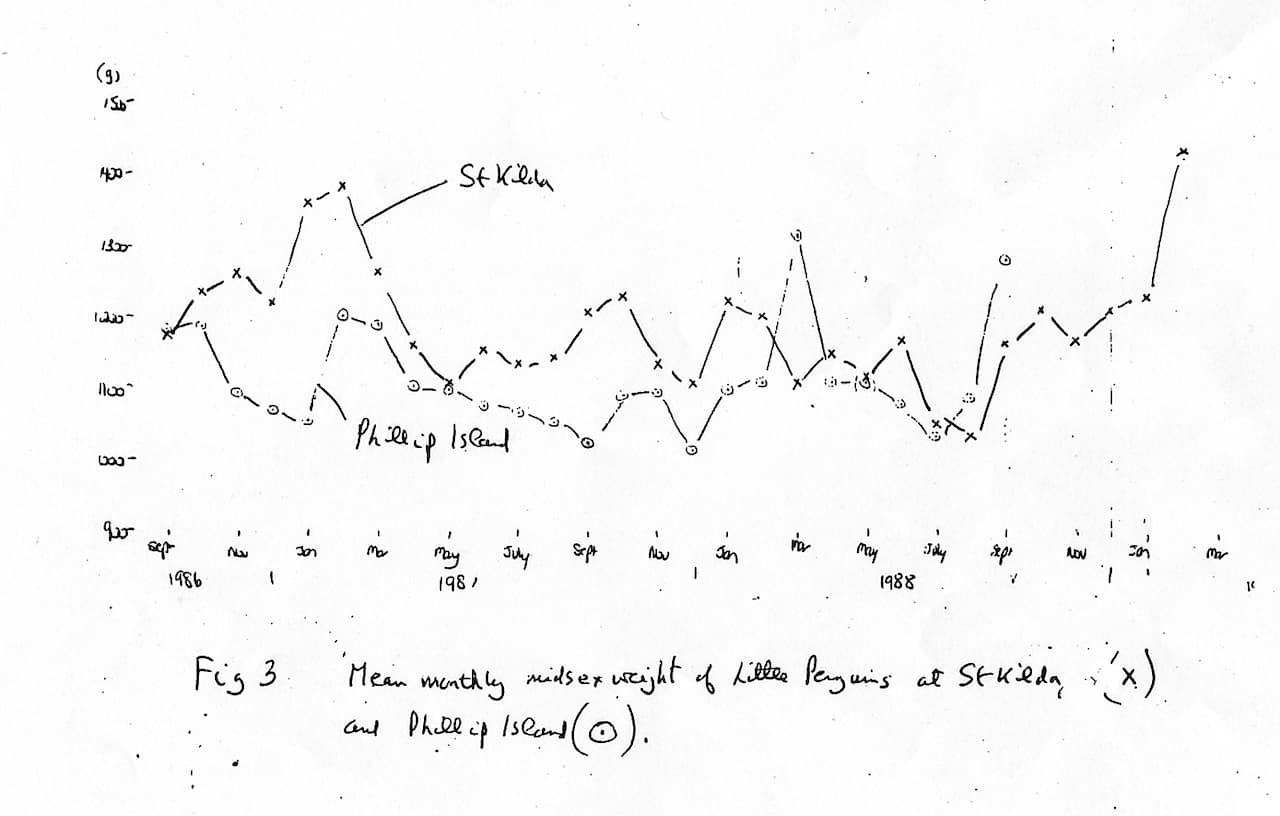
Male Little Penguins average heavier in weight than females though there is considerable overlap at any time of year. Fig 4 shows the “mid- sex weight” at St Kilda, half way between the mean male and mean female weights. Weights vary considerably during the year reflecting in part food in the stomach (Montague & Cullen l988).The greatest changes follow the breeding season. Prior to moult both sexes increase; in weight preparing for the starvation period when they are ashore; and when moult is over they are well below their average weight (Stahel & Gales 1986).Thus weights during this
season of moult are highly variable, and the mean, based on small samples such as we weighed at- St Kilda., potentially misleading. Fig.3 also shows mean monthly mid—sex weights at Phillip Island, based on much larger samples .Over, most of the period the St Kilda weights were higher.
RETURN TO THE COLONY OF YOUNG BIRDS
At Phillip Island the birds first return to breed when they are 2 or3 years old (Dann & Cullen 1989).and a few return to moult at 1 year(Reilly & Cullen 1982) Although only a small number of chicks have been banded at St Kilda. (15 in 1986-7, 11 in 1987-8, 12 in 1988-9.), seven have already been recorded returning to the colony. Such visits have been in the breeding season, the time of year when visitation rate by penguins to the colony is highest (Fig.2) One female was recorded with eggs at two years old . another bird returned at one year old and moulted in the nest where it was born.
After the first year of this study most of the birds using accessible sites in the colony appear to nave been banded and we encountered relatively few unbanded adult birds.For the two years from Apr 87 to Mar 89 the number of unbanded adults encountered was 8.3% (out of 544 handled). Some of these would probably have been new recruits of young birds to the St Kilda population. There was a slight concentration of these records from October to January, but again the distribution closely paralleled the monthly distribution of visitation rate by all birds (Fig. 2).
INJURIES
Birds at St Kilda showed more injuries than penguins we have seen at Phillip Island. Several times we had to liberate birds inextricably tangled in six—pack yokes. Some birds had fine nylon fishing line would round the tarsus of one leg . The foot of one such bird had fallen off, apparently due to the restricted blood supply, and the leg bones were protruding. Two others had no foot on one leg but a well healed stump . (The birds seem able to manage surprisingly well on land with only one foot, and in the water where they progress by “flying” it hardly matters.) The shoreline along the breakwater abounds in such rubbish and the birds worsen the situation by sometimes carrying in such stuff as nest material. Some of the birds we found tangled in materials described above survived after being liberated but others, especially when their body weight was low, were subsequently found dead. One of the one—legged birds, a male, was incubating eggs in 1988.
One adult was found dead in a nest burrow and an autopsy indicated that it may have died from lead poisoning : chemical analysis of liver and kidney indicated unusually high levels of lead and there was a (fisherman’s?) lead weight in the stomach (Harrigan1988) Dr Harrigan has also told us of two penguins he has autopsied from Port Phillip Bay which seemed to have died of starvation aggravated by peritonitis requiting from artificial objects they had ingested piercing the gut wall. A number of birds were noted to have other minor injuries such as holes in the webs of their feet or damage to the toes.
DISCUSSION
St Kilda Penguin History
Little Penguins have probably been using the St Kilda breakwater for a number of years since 1956 when it was built for the Melbourne Olympics. The only documented evidence refers to a pair nesting in 1974. (Eades 1975, incorrectly printed as Eames, together with unpublished details:, recorded by P. Balmford of the Penguin Study Group), though fishermen currently using the area have told me that they have seen penguins coming ashore “for at least twenty years”. The 1974 records mention only two breeding sites, one with eggs one with chicks in spite of 13 documented visits to the location during what would probably be the peak of the breeding season. Two other sites were noted “splashed with guano” but no birds seen . Most of the visits seem to have been by day when penguins ashore are out of sight and do not call. Specific mention is made of only one night visit, the best- time to detect penguins if they are present. Nevertheless the best guess I can make at the moment is that the colony has probably substantially enlarged since 1974.
PRESENT POPULATION SIZE
From our banding results we’ can say that at least 100 penguins must be using the St Kilda breakwater. Given the normal, adult mortality rate some of those originally marked have probably died by now but besides these we banded, there are certainly more birds present which are impossible to reach because of the labyrinthine structure of the breakwater. How many more is anyone’s guess, perhaps 1O%, perhaps 50%. Our figure for breeding numbers are also certainly an underestimate but a figure of 20-40 pairs seems not unlikely. Over the three years of our study we have not detected what we consider to be real changes in breeding numbers.
ORIGIN OF THE ST KILDA COLONY
Besides the St Kilda colony, we know of only isolated reports of breeding locations for penguins within Port Phillip Bay. The only published account is for South Channel Fort, at the south end of the Bay (D. Venn, cited in Harris, Dearson &. Brown 1980).David Venn tells me that he found half a dozen burrows, in use among the rocks on the Sorrento side in the years 1977-78 and 1978-79 when he visited the island. Peter Dann of the Phillip Island Penguin Reserve staff visited the island in September 1985 but found none of the characteristic evidence of penguins. Nor did I twenty months later. However on 23-30 Oct 1987 Ian Tenby found one live chick under an Atriplex bush. Evidently the site has not been totally abandoned by penguins, though numbers are small. In Aug 1968 two penguins were found in burrows and banded by Pauline Reiliy on Mud Island in Feb 1971 (pers. comm. ) and on 12 Oct 1988 Ian Tenby found an adult incubating an egg under a saltbush on Boatswain Island, part of the Mud Island group (pers. comm.) From time to time we have been told of penguins at other locations around the Bay but on investigation none has given evidence of regular use or breeding. Quite possibly isolated birds or pairs may find haven around the Bay in scattered sites , and even breed, but the evidence at present available suggests that such occurrences are very small scale and irregular. It is possible that this impression is because some of the potential sites are not regularly checked under conditions favourable to detect penguins. Brighton Yacht Club ?
One of. the principal Victorian breeding colonies of Little Penguins is at Phillip Island, outside Port Phillip Bay about I00 km by sea from St Kilda. From this colony of several thousand pairs, considerable numbers of penguins come into the Bay during winter (Norman 1967),and from the recoveries of bands, most if not all of these birds probably come from Phillip Island (P. Dann).This is confirmed by radio-tracking individually
marked birds which can travel to Hobsons Bay in the St Kilda area in less than 4 days (Weavers 1987).It seems likely therefore that the St Kilda population originated from some of these Phillip Island birds colonising the breakwater after its’ construction in 1956.However in spite of over 15,000 having been banded over the years at Phillip Island (Dann & CuIIen 1989) we have not yet come across a single one at St Kilda. It is likely therefore that the present small colony is self-sustaining and would not be quickly replaced if it disappeared.This is consistent with the limited evidence that suggests that birds banded as chicks at St Kilda are returning there as they approach maturity, and at least one such bird has nested. From the time of year when unbanded birds were likely to be encountered (following the initial intensive banding in the first year) new recruits to the colony seem not to favour particular months but turn up whenever visitation rates of all birds are highest.
COMPARISON WITH PHILLIP ISLAND
There are several interesting differences that the St Kilda penguins show in comparison with those from Phillip Island.
(1)The St Kilda birds started breeding earlier than those on Phillip Island in the three years for which we have information (Table 2),and this even though we were certainly sampling a much smaller number of pairs than at Phillip Island. The end of breeding on the other hand agrees closely with Phillip Island.
(2)Chick weights at banding were significantly higher than at Phillip Island (Table 2). These are an important indicator of breeding success. (Really & Cullen 1981) and the prospect of surviving the crucial first year at sea (Dann 1989).
(3)In line with this, a relatively high proportion of the few chicks banded have re-appeared at the natal colony in their first and second years of life.
(4)The weights of adults penguins at St Kilda tended usually to be higher than at Phillip Island, another indicator of favourable conditions (Fig.3).
The most likely reason why the St Kilda penguins do better than those at Phillip Island is to do with the food supply. Little Penguins eat principally fish with some squid (Montague & Cullen 1988) and food supplies within Port Phillip Bay may be favourable, as indicated by the fact that the Phillip Island adults move into the Bay to feed during some winter months (see above). The north end of the bay, Hobsons Bay which includes the St Kilda area. possesses shallow sandy areas with seagrass beds which could provide suitable spawning grounds and nurseries for young anchovies, one of the principal food species of the penguins at Phillip Island. What the St Kilda birds eat is not known but it probably consists of similar small fish. Schools of such prey (atherinids, anchovies and perhaps; other clupeids) are sometimes recorded from St Kilda Harbour and penguins have been seen feeding within the harbour, sometimes a number of records from the same week.
Whether feeding within the harbour is of special significance for the St Kilda birds they must be better situated in relation to their Port Philip Bay food resource in general than the. birds nesting on Phillip Island. One respect in which the St Kilda birds certainly do less well is with regard to pollution by plastic waste, causing more frequent injuries. The proximity of boats and possible oil spills in the St Kilda harbour presents a potential hazard, but on only one occasion have we recorded detectable oiling of plumage, and then only slightly, involving a few birds. This remains a risk however as the birds approach the breakwater from the sheltered, harbour side in order to come ashore.
WHAT LIMITS THE NUMBERS AT ST KILDA ?
The evidence available at present suggests that feeding conditions are favourable at St. Kilda (though of course they may not have been in the past)and that young birds are surviving well to breeding age. Might the colony increase further? For many seabirds nest sites are a potential limitation to breeding numbers. But as far as we can see these would be superabundant at St Kilda given the instrinsic structure of the breakwater. Some of thesites, particularly those most accessible to us, may be at risk from human disturbance with or without the addition of dogs which currently, and in the past, promenade along the breakwater. In addition, in the virtual absence of any vegetation to consolidate the soil, we have seen subsidence on the breakwater in some places eliminating existing penguin nest sites. Whether such hazards have limited the growth of the colony in the past we do not know .We have encountered some concern about the possible impact of rats on the penguins. At night it is not unusual to see a water rat Hydromys chrysogaster swimming close to the breakwater and occasionally we found their small food middens on the edge of the water, but though reported to be “an opportunistic predator” (Strahan -1983) we found no evidence that they interfere with the penguins. Other species of rats might be more serious but we have never seen them.
MANAGEMENT CONSIDERATIONS
The proximity of urban man has created special hazards for the St Kilda colony. More birds than at Phillip Island suffer from various types of “pollution”. These have been detailed above, including clear evidence of severe injury and loss of life due to discarded fishing equipment and plastic six — pack yokes.
Additional dangers to the St Kilda penguins when ashore are posed by the following, though it is difficult at present to Quantify their significance .
(1)Dog predation. People exercise their dogs on the breakwater . The latter can readily check out penguin burrows by scent and could savage birds .
(2)Human vandalism. Some nests are quite visible on the surface.
(3)Accidental human interference in the evenings, when the birds are coming ashore. They are reluctant to land and make their way across the breakwater to their burrows with people in view.
(4) Further subsidence of the breakwater with loss of nesting burrows.One should also mention some of the man-made hazards at sea.
(5)Oil pollution can be serious for birds such as the penguins which fail to recognise its danger .Oil not only impairs the waterproofing qualities of penguins’ feathers but it is ingested as the birds try to preen themselves, often resulting in pneumonia. Penguins not only approach the breakwater from the harbour side but may spend time feeding within the harbour (at least in certain months).Thus there is a high priority that conditions within the basin must prevent and control accidental spillage of Fuel oil.
(6)The St Kilda birds must do most of their feeding within Port Phillip Bay, which is also the feeding around of Phillip Island. birds in winter (see above). There is some cause for concern here since it is estimated that when they are within the Bay during winter the Phillip Island birds need about 5O tonnes of small fish per month (piIchards, anchovy, sprat) to survive (Cullen 1987). From available fishery statistics it is not clear whether existing stocks within the Bay can provide this at the same time as supporting a fishery for these species which has quadrupled in ten years .
Finally it may be mentioned that the small penguin colony at St Kilda would be quite inappropriate for a tourist development of any kind like that at Phillip Island. The colony is far too small, the evening visitation rate by the birds too low and too dispersed to be worth even considering the long be training period which would be necessary to accustom the birds to lights. The colony will only survive if disturbance is held to a minimum, and even then only assuming some untoward even such as an oil spill does not wipe out the population.
ACKNOWLEDGEMENTS
Particular thanks must go to the three people who have come out over one hundred Sunday evenings over the past three years! Neil Blake, Hariett Fett and John Munroe. The paper represents the results of their untiring work. Many others have taken part in our surveys and their encouragement and interest is gratefully acknowledged, especially Pauline Benzie who first introduced me to the St Kilda penguins. At all times I have profited from discussions with Peter Dann of the Phillip Island Penguin Reserve for his wide experience of the species.
Table 1. Breeding season statistics for St Kilda breakwater
| 1986-87 | 1987-88 | 1988-89 | ||
| First date eggs/chicks recorded | 10 August* | 30 August | 14 August | |
| Last date chicks recorded | 1 March | 13 March | 26 February | |
| Weight of Chicks at banding | Mean(g) | 1307 | 1051 | 1176 |
| St.dev. | 197 | 186 | 136 | |
| n | 15 | 11 | 11 | |
| First date moulting recorded | 1 January | 17 January | 15 January | |
| Last date moulting recorded | 9 March | 13 March | 26 February |
- excluding isolated record of 10 June
Table 2. Comparative breeding data from Phillip Island (courtesy P. Dann)
| 1986-87 | 1987-88 | 1988-99 | |
| Start of Breeding | 19 August | 1 September | 31 August |
| Mean Chick weight at banding | 957 | 820 | ? |
| Start of moulting | 13 January | ? | ? |
Fig.1
Minimum number of adults present at St Kilda in each month. Individual values as dots. Mean numbers joined by line.
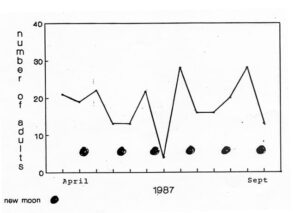
Minimum number of adults estimated present
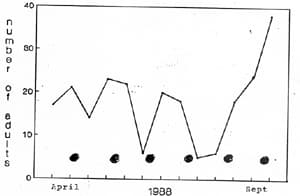
Fig2. Minimum number of adult penguins present at St Kilda on visits April to September
1987 and 1988 Dates of new moon shown on same scale.